Every domain’s expiry date,
whichever registrar it is at.

A few domains at Namecheap, one at Porkbun, the rest on Cloudflare: each registrar sends its own reminders, and one of them lands in spam. Assetboard keeps every expiry date in one list on your Mac and warns you before a domain lapses.

Paste a domain, get its expiry date

Paste a domain or a web address and the domain form opens with the expiry date and registrar filled in from the registry over RDAP. Paste a list and each domain gets its own record. Some TLDs have no RDAP lookup, for example .cn, .io and .de; for those you enter the date yourself.

Lookup
RDAP; sends only the domain name
A list
One record per domain
No RDAP
.cn · .io · .de, by hand
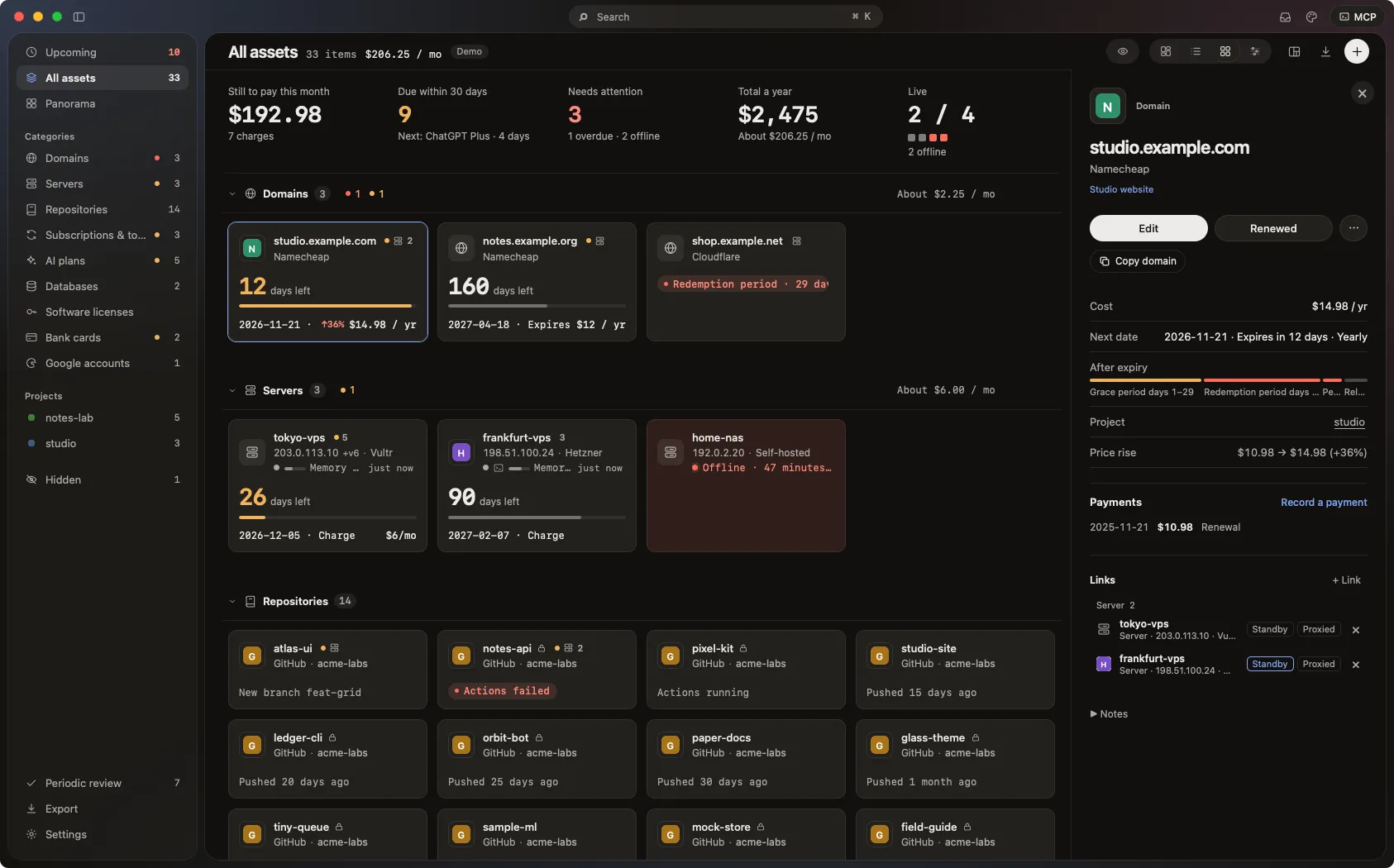
The grid view: one card per asset with days left, cycle and cost

Bring them in from the registrar

Connect Namecheap or Porkbun with an API key you paste, or Cloudflare with a read-only token; keys stay in the macOS Keychain. New domains are listed first and written only after you tick them. Cloudflare gives expiry dates only for domains registered at Cloudflare, and only if the token can read Registrar data; a DNS-only zone has no date.

Registrars
Namecheap · Porkbun · Cloudflare
Also
Domains in Vercel
Access
Read-only; keys in the Keychain
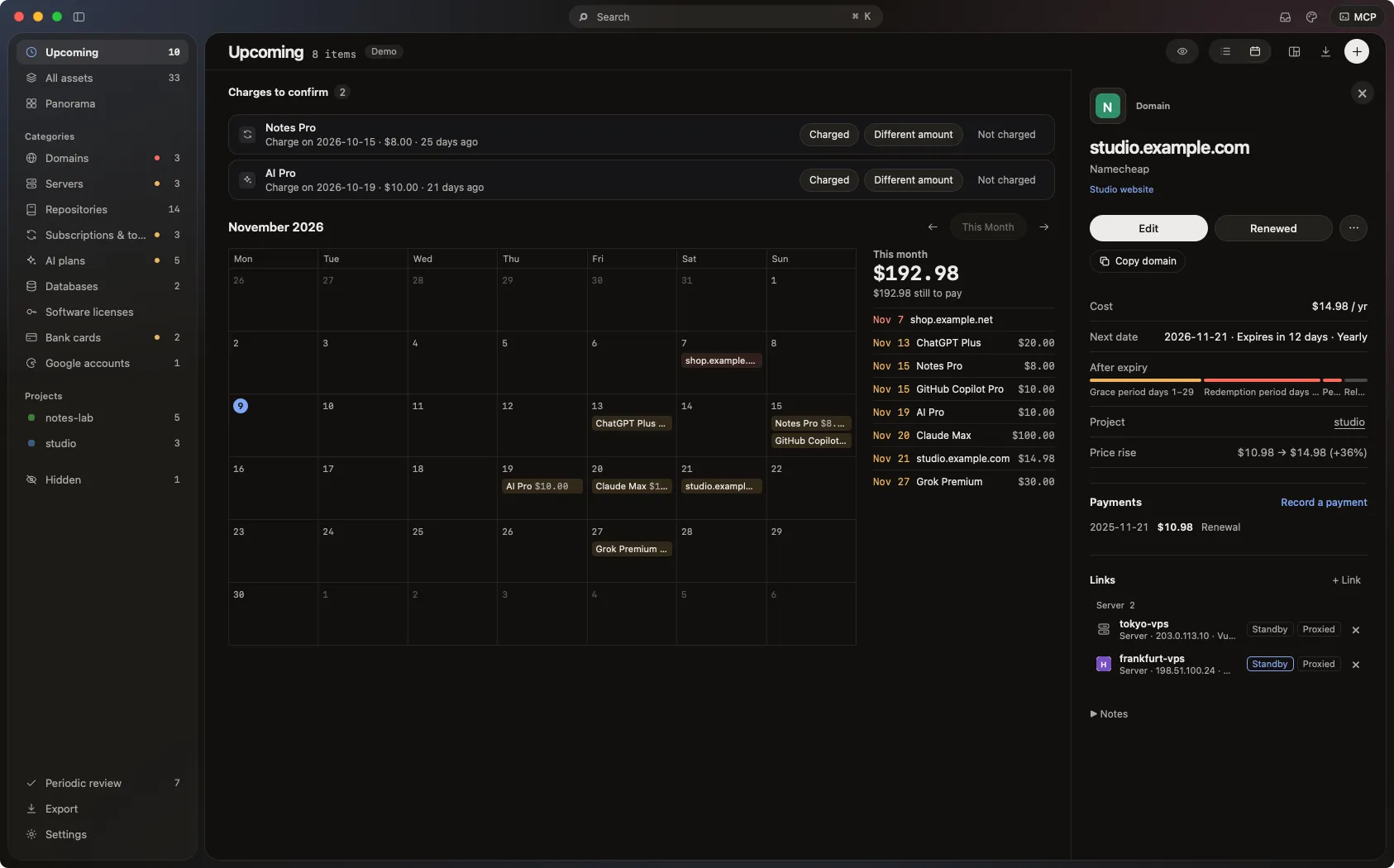
The Upcoming calendar: expiries and charges on each day

Before it lapses, and after

A system notification comes 30, 7 and 1 days before expiry, even when the app is closed. Once a week the app checks each domain’s expiry date and status at its registry: frozen domains turn red, and a changed registrar or nameservers is flagged. After expiry it shows whether the domain is in its grace or redemption period.

Notifications
30, 7 and 1 days before
Registry check
Weekly, and by hand
Calendar
Export as .ics
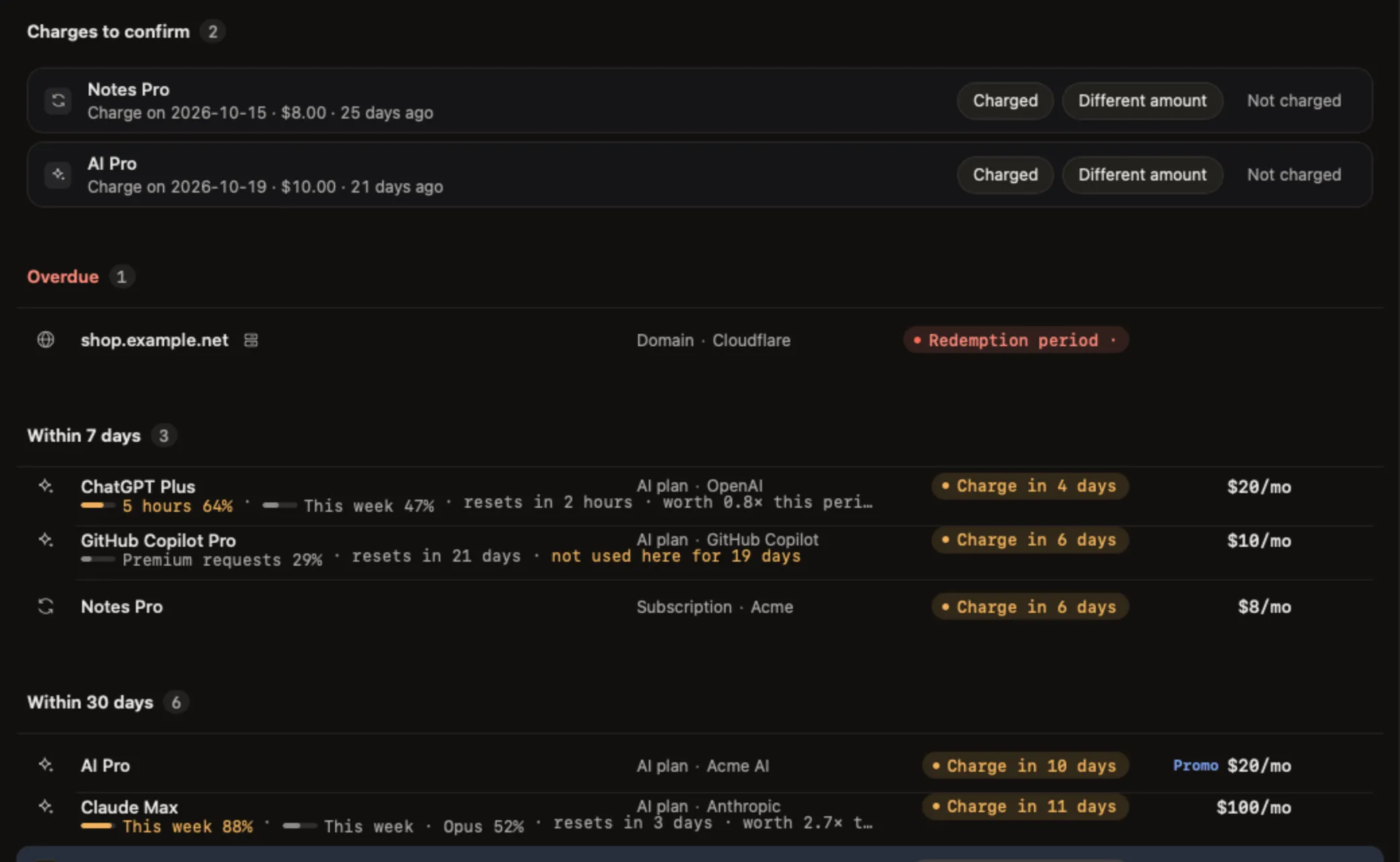
Upcoming: two charges to confirm at the top, then overdue, within 7 days, within 30 days and later

Screenshots are from demo mode; the data is fictional.

Questions

Which registrars does it work with?

Any. You can paste or type any domain, and its expiry date comes from the registry over RDAP where the TLD has it. Namecheap, Porkbun and Cloudflare can also be imported directly, as can the domains in a Vercel account.

Does it use WHOIS?

It uses RDAP, the registries’ structured successor to WHOIS, and sends only the domain name. Some TLDs, for example .cn, .io and .de, have no RDAP lookup, so you enter those dates yourself.

Does it renew domains for me?

No. It reminds you and shows the date and status; you renew at your registrar.

What do I need to run it?

A Mac with Apple Silicon and macOS 15 or later. The data stays in a local file on the Mac, with no account.

Where the data lives

In a SQLite file on your Mac. No account, no cloud sync, no telemetry in the app. Free and open source (GPL-3.0); the source is on GitHub.